● open source · MIT · your infrastructure·from the makers of n-dx

An SEO, self-hosted.

n-seo reads Search Console and GA4 every morning, probes your sites for what quietly broke, and hands you a ranked queue of concrete moves — with the numbers attached. No account, no SaaS. It briefs you; it never posts for you.

npm install -g n-seo then n-seo init my-sites
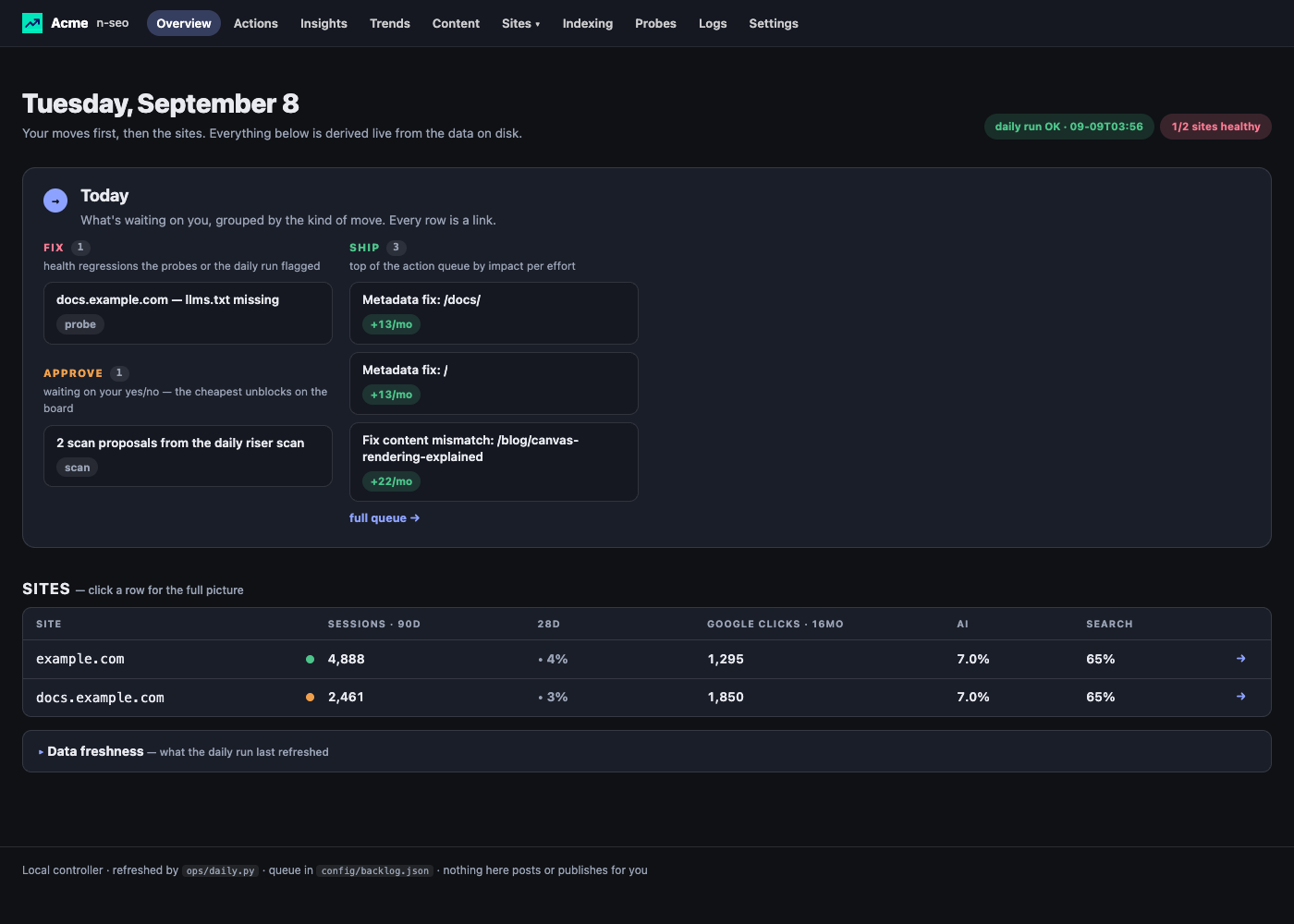
n-seo overview: the Today board grouping what is waiting on you — Fix, Approve, Ship — above a per-site strip of sessions, clicks, AI-referral share and search share

The overview on demo data. Every row is a link; every number is derived live from files on your disk.

Data

Yours, on your hardware

Laptop, VPS, NAS or a VM in your own cloud. Nothing leaves the host except calls to the Google APIs you authorize. No account, no SaaS, no telemetry.

Judgment

Evidence first

Every card shows the queries, positions and impressions behind it, then the move, then a spec. You learn what actually moves the numbers.

Hands

It briefs; you act

No module edits your site, sends an email or posts a comment. Community modules write briefings. The words are always yours.

Quickstart

Five minutes, no Google setup

The demo dataset populates every page, so you can see what the tool does before you connect anything. Node 20+, Python 3.10+, curl and openssl are all it needs.

# see it working
npm install -g n-seo
n-seo init my-sites && cd my-sites
n-seo demo          # synthetic data for example.com
n-seo start         # → http://localhost:4600

# connect your sites
# edit n-seo.config.json, then:
n-seo doctor        # checks key + access
n-seo daily         # the morning run, by hand

Try it on demo data

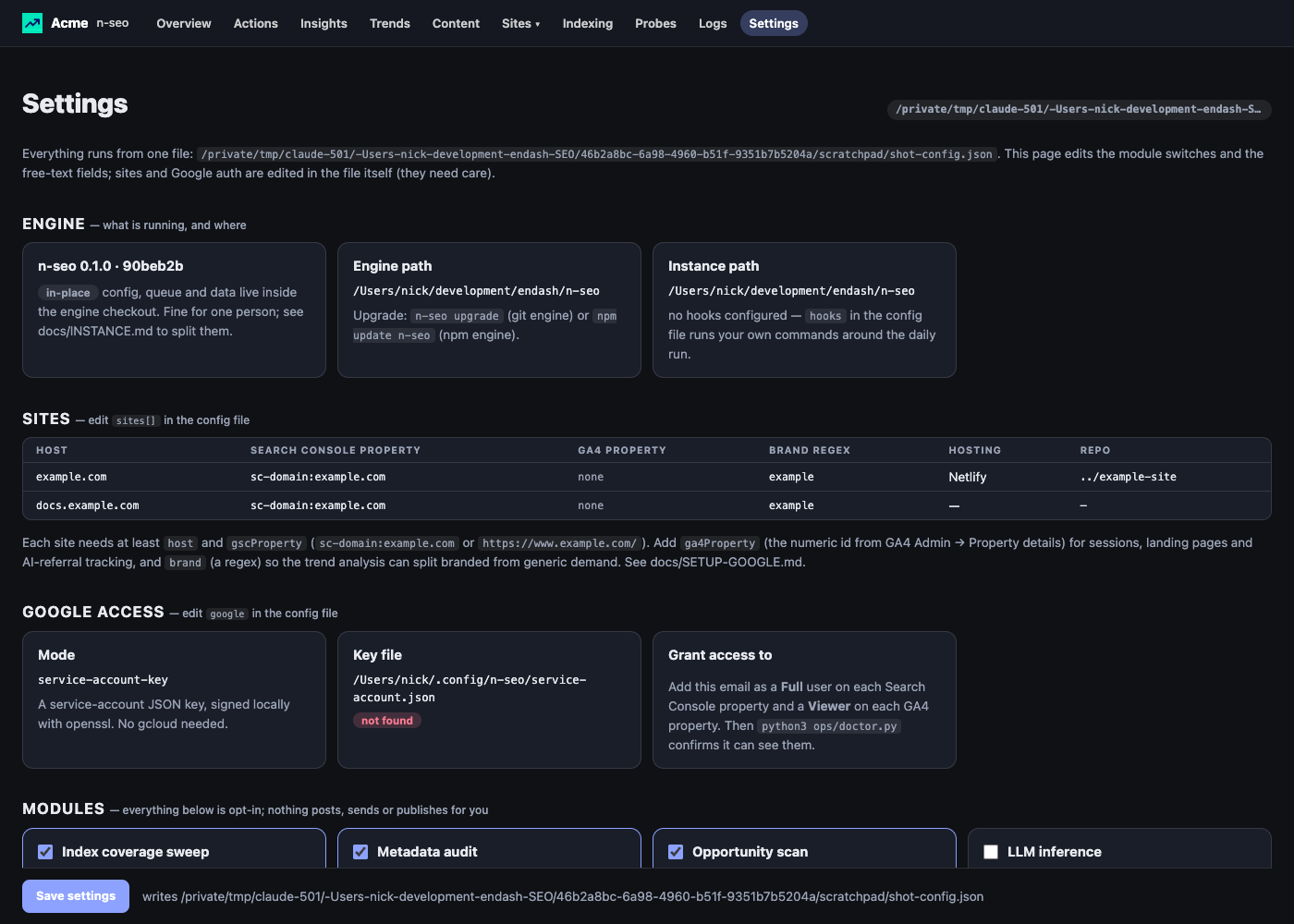
Every page, every card, every chart — populated. Poke around the queue, open a spec, toggle a module in Settings.

Give it read access

One Google service account, added as a user on Search Console and GA4. The key is signed locally with openssl — no gcloud, no pip installs. Step by step →

Schedule the morning run

launchd on macOS, cron or systemd on Linux. It waits for the network, retries once, logs every step, and tells you when something failed. Scheduling →

Ship what it tells you to

In your own repo, your own way. The next morning's data says whether it worked, and the card moves to watching instead of disappearing.

How it works

What an agency does every month, as a loop that runs every morning

Four planes. The first and second are automated; the third is you (or your AI agent); the fourth is what makes the second one honest.

01 · awareness

Pull everything

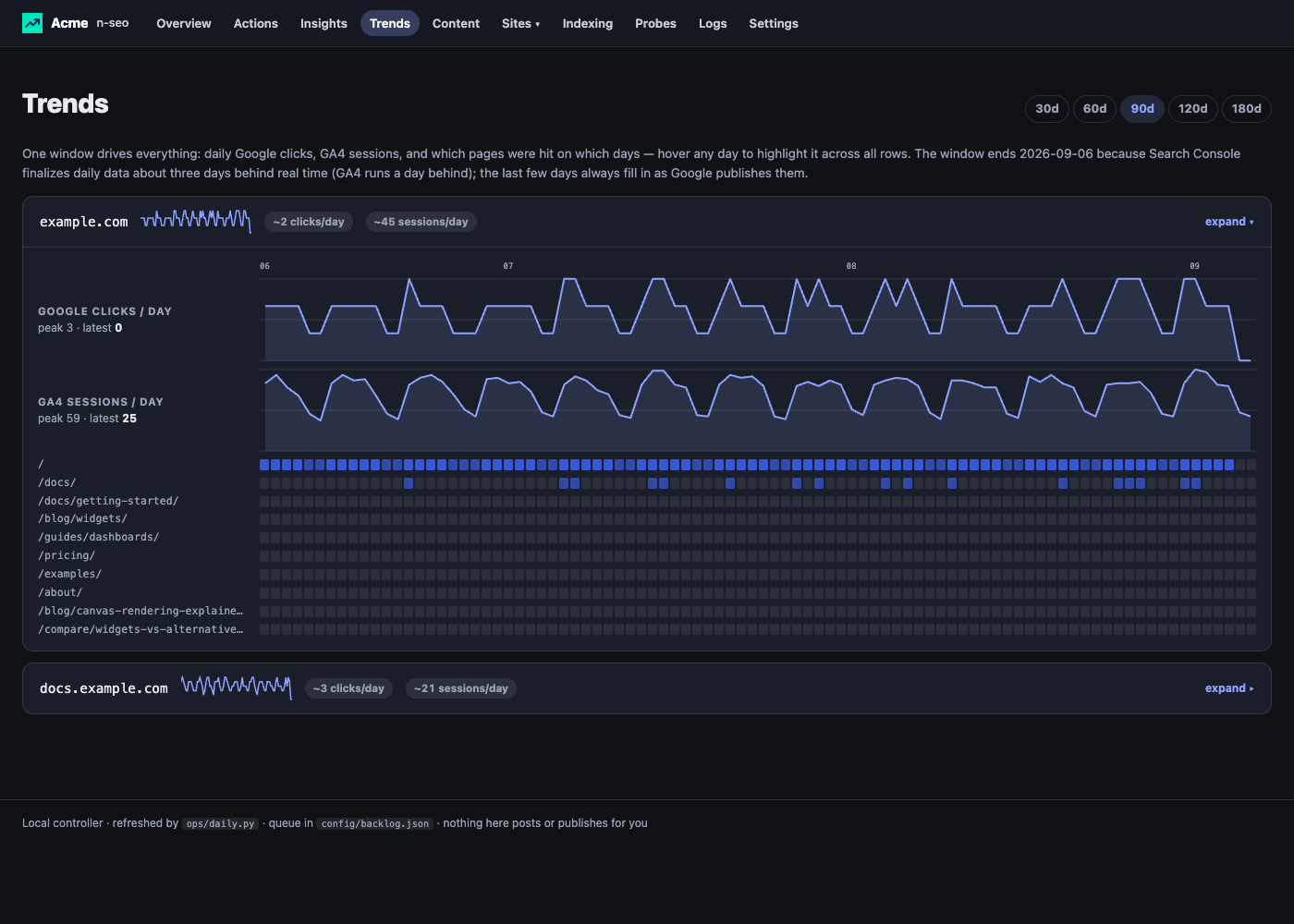
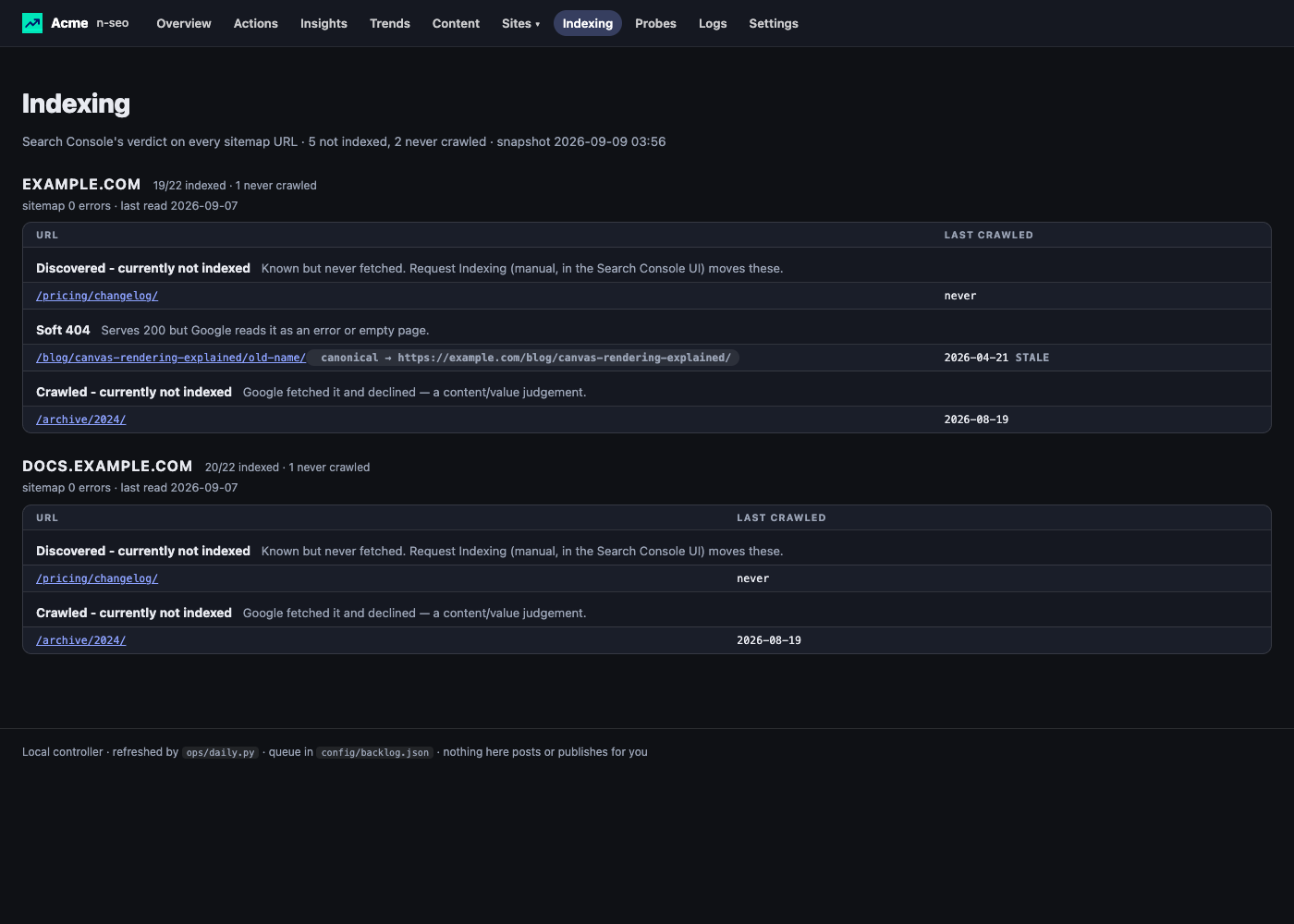
Search Console (16 months and the trailing 90 days), GA4 sessions, sources and landing pages, per-page time series, URL Inspection verdicts for every sitemap URL, and a no-auth probe of each site: robots, sitemap, llms.txt, soft 404s, blocked AI crawlers, JS-only shells.

02 · analysis

Rank the moves

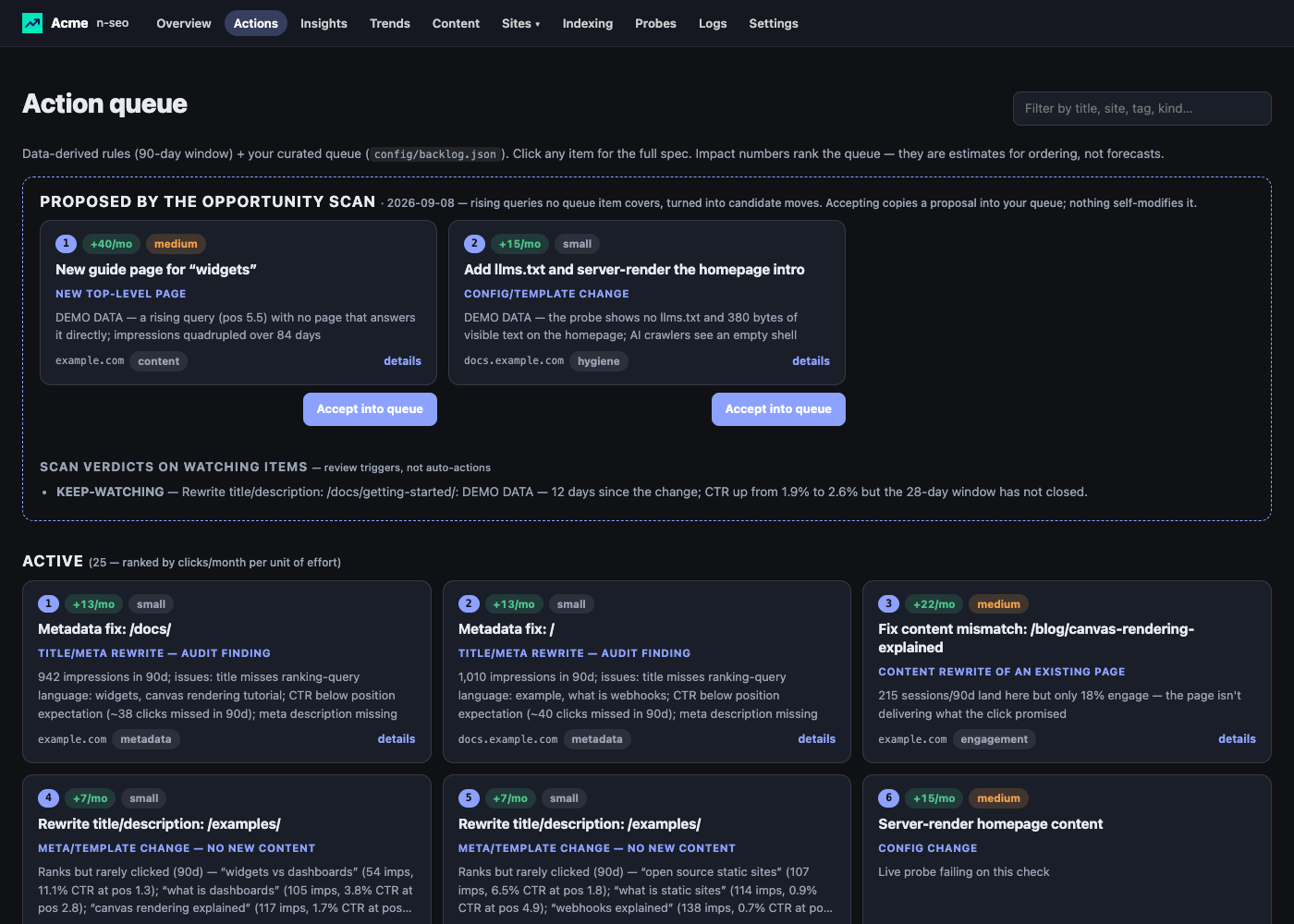
Rules over the 90-day window turn snapshots into actions: metadata that misses the ranking language, pages that rank well but rarely get clicked, queries sitting at position 5–15, landing pages that don't deliver what the click promised, traffic drops. Impact per unit of effort orders the queue.

03 · action

You ship

Each card opens to the evidence, the move and a build spec. You change the title, add the section, fix the 404 — in your repo, on a branch, your way. Accept machine proposals into your queue with one click; nothing self-modifies it.

04 · measurement

The data decides

Shipped work becomes watching, never deleted. Watched pages are reported in the daily log; the scan judges whether a change succeeded, failed or needs more time. That feedback is how you hone your own principles.

What you get

A dashboard that leads with what to do next

Server-rendered, no bundler, light and dark. Compact, searchable, and split cleanly into active work and shipped work being measured.

Also: per-site pages (striking distance, CTR gaps, landing pages, AI-referral sources), Insights, Probes, Logs, Content (drafts, campaigns, participation briefings).

The rules

The principles an agency charges for, written down — and yours to edit

n-seo ships with an opinionated operating model. Each rule is a few lines you can read, argue with and change. The queue shows you why it thinks so, every time.

28-day title freeze

After you rewrite a page's title or description, leave it alone for four weeks. Churn reads as manipulation and resets Google's evaluation. Measure, then move.

≈8 metadata changes a week

Twenty-five title rewrites in one afternoon is a pattern. Stagger the batches across your sites.

90 days decide; 16 months remember

Decisions ride the trailing 90 days so a fix you shipped last week stops being accused. The long window is for totals and history.

Impact orders, never forecasts

The clicks-per-month number on a card exists to rank the queue. It is not a promise, and the tool never reports it as one.

Shipped → watching

Done work stays on the board with a dated note until the data has spoken. Deleting it is how you forget what you learned.

Briefings, never comments

Community participation is human. The tool finds the thread and briefs you on the gist, the debate and your genuine angle. It will not write the words.

Why "hone your own principles"? Because the rules above are a starting point, not a doctrine. Every rule in the action engine is a plain TypeScript function with a threshold you can see. When a card is wrong, you learn why; when it is right, you learn what moved. After a few months the queue reflects what works for your sites, and you can explain every line of it.
Bring your own agent

Your AI agent gets the same view you do

A read-only MCP server exposes the queue, per-site metrics, the metadata audit, index coverage, trends and ops health. Claude Code picks it up from the repo's .mcp.json with no setup; Claude Desktop and other clients use stdio or an authenticated HTTP endpoint.

Read-only is the point: an agent can reason over your search data all day and still cannot bypass the freeze, the batching, or you.

What should I do first this week, and why?
Which pages on example.com rank well but rarely get clicked?
Did last week's title change on /pricing move anything yet?
Which sitemap URLs has Google never crawled?
Draft the spec for the top striking-distance page as a PR description.

15 tools, 3 doc resources, every one annotated read-only. MCP docs →

Modules

Opt in, and honest about what each one touches

Everything beyond the core pulls is off until you turn it on. Nothing here posts, sends or publishes on your behalf.

ModuleWhat it doesNeedsDefault
Index coverage sweepURL Inspection verdict for every sitemap URLSearch Console accesson
Metadata auditFetches each ranking page's live title and description, judges them against the queries it ranks foron
Opportunity scan84-day trend refresh; rising queries no queue item covers become candidateson
LLM inferenceTurns candidates into proposals and watched items into verdicts; writes digest briefingsany CLI that reads a prompt on stdin — claude -p by defaultoff
Hacker News digestFinds fresh threads in your expertise areas and briefs you on eachyour HN usernameoff
Reddit digestSame for subredditsa free Reddit "script" app's credentialsoff
IndexNowKey generation and pings to Bing / Copilot / Yandex on publishoff
Static exportSnapshot the dashboard to HTML for a mirror behind your own authoff
Git auto-commitCommit the daily log after each runa git remote, optionallyoff
NotificationsDesktop notification when a step failsmacOSoff
Cost

Free means free

No SaaS, no account, no seat price. MIT licensed. Clone it, run it, fork it, ship it inside your company.
Google's APIs are free within quota. Search Console and GA4 reporting cost nothing at this scale; the index sweep is capped well under the daily limit.
Bring the LLM you already have — or none. The core loop needs no model at all. The inference module runs whatever command you give it, or calls an endpoint you choose, with your prompt.
We run our own sites on it. n-seo is the generalized version of the control plane En Dash uses for its own portfolio every morning. When it breaks, we notice first.

Stop paying someone to read Search Console for you.

Run the demo, connect a site, read the queue tomorrow morning.